


With the development of industrial automation, automated powder coating lines have become the first choice for many enterprises, which can improve production efficiency and ensure stable coating quality. However, there are various types and specifications of automated powder coating lines on the market, and many companies tend to blindly follow the trend when selecting, resulting in improper selection and problems such as "overusing" or "insufficient production capacity", wasting costs. Today, based on the production needs of enterprises, we have compiled a selection guide for automated powder spraying lines to help enterprises choose according to their needs and accurately match production requirements.
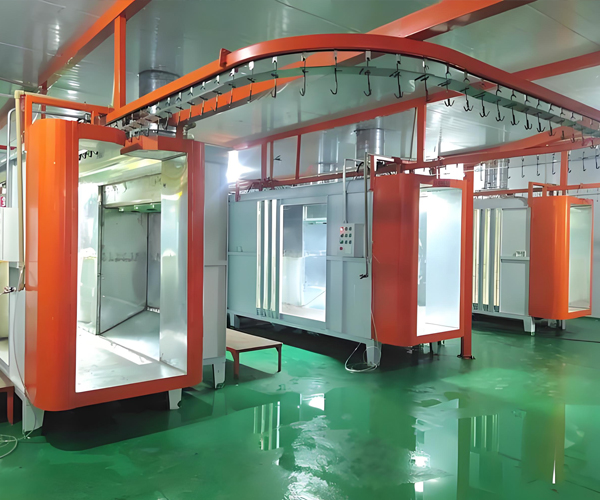
1、 Before selecting, it is necessary to clarify three core requirements
The core of selection is "adaptation", not "the more expensive the better". Before selecting, enterprises need to clarify their three core requirements in order to accurately match the powder coating line configuration.
(1) Clarify product characteristics
Focus on the material (steel, aluminum, plastic, etc.), size, weight, and coating requirements (thickness, color, wear and corrosion resistance) of the workpiece. For example, for small precision workpieces (such as hardware fasteners), it is suitable to choose a small automated powder spraying line and pay attention to spraying accuracy; For large workpieces such as shelves and guardrails, it is suitable to choose a large suspended automated powder coating line to ensure comprehensive coating coverage.
(2) Clearly define the production scale
Determine the production efficiency of the powder spraying line based on its daily and annual output. For example, small and medium-sized enterprises with a daily output of less than 1000 pieces can choose semi-automatic or small fully automatic powder spraying lines; Large enterprises with a daily output of over 1000 pieces need to choose a large fully automatic powder spraying line, equipped with multiple spray guns and long curing furnaces, to achieve continuous production and improve efficiency.
(3) Clearly define budget and environmental requirements
The budget determines the degree of automation and configuration level of the powder spraying line. Enterprises need to combine their own budget and choose the most cost-effective solution to avoid blindly pursuing high configuration and causing waste. At the same time, it is necessary to clarify local environmental protection requirements, select powder spraying lines that meet environmental impact assessment standards, and equip them with complete dust recovery devices to ensure environmental compliance.
2、 Key points for selecting the core of automated powder spraying line
(1) Selection key point 1: degree of automation
Automated powder spraying lines are mainly divided into two types: semi-automatic and fully automatic. Enterprises can choose according to production volume and labor costs: semi-automatic powder spraying lines require manual assistance for loading and unloading, suitable for small and medium-sized batch production, with lower investment costs; The fully automatic powder spraying line realizes the automation of the entire process of feeding, spraying, curing, and discharging, without the need for manual intervention. It is suitable for large-scale continuous production and can significantly reduce labor costs and improve production efficiency, but the investment cost is relatively high.
(2) Selection Point 2: Core System Configuration
The configuration of the core system directly affects the performance and spraying effect of the powder spraying line, with a focus on three systems: first, the powder spraying system, prioritizing the use of spray guns with good atomization effect and static stability, and mass production can choose robot spray guns to improve spraying accuracy and efficiency; The second is the solidification system, which selects a suitable solidification furnace according to the powder type to ensure the solidification effect. Large production lines can choose multi zone temperature controlled solidification furnaces to improve solidification stability; The third is the recycling system, selecting recycling devices with high recovery rates (≥ 95%) to reduce powder waste and lower costs.
(3) Selection Point 3: Workshop Layout Adaptation
When selecting, the length, width, and installation method of the powder spraying line should be determined based on the area, height, and layout of the workshop. For example, if the workshop area is small, a compact powder coating line can be chosen to make reasonable use of space; The workshop height is insufficient, and a low height curing furnace needs to be selected to avoid installation failure. At the same time, it is necessary to reserve space for equipment maintenance to facilitate subsequent operation and maintenance.
(4) Selection Point 4: Manufacturer's Strength and After sales Service
The powder coating line is a large-scale equipment with a long service life, and after-sales support is crucial. When selecting, give priority to manufacturers with strong strength and good reputation to ensure that the equipment quality meets the standards; At the same time, confirm whether the manufacturer provides one-stop after-sales services such as installation, debugging, training, and maintenance to avoid equipment failures that cannot be resolved in a timely manner and affect production.
3、 Selection and Avoiding Pits Reminder
1. Do not blindly pursue high automation: If the output is small, choosing a high automation powder spraying line will lead to idle equipment and waste costs; 2. Do not ignore the pre-treatment system: pre-treatment is the foundation of spraying effect, and a complete pre-treatment system should be matched when selecting to avoid affecting coating quality due to inadequate pre-treatment; 3. Do not ignore environmental protection configuration: If the local environmental control is strict, it is necessary to confirm the environmental protection configuration of the powder spraying line in advance to ensure that it can pass the environmental impact assessment and avoid subsequent rectification.
