


During the long-term operation of the powder spraying line, various faults are inevitable, such as coating peeling, uneven powder adsorption, incomplete curing, etc. These faults not only affect production efficiency, but also increase rework costs and even damage equipment. Today, we will summarize the 5 most common types of faults in the powder coating line, analyze the causes of the faults, and provide practical solutions to help factory staff quickly troubleshoot and efficiently solve problems, ensuring smooth production.
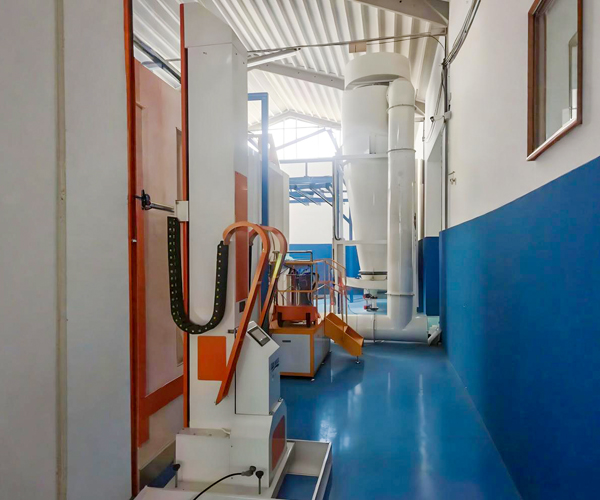
1、 Classification and solution of core faults in powder coating line
(1) Fault 1: Poor adhesion of the coating, easy to peel off and powder fall off
This is the most common malfunction of the powder coating line, mainly manifested as the powder falling off with a gentle scrape by hand after the powder has solidified, or the coating peeling off extensively during subsequent use. There are three core reasons: firstly, the pre-treatment is not thorough, and there are still impurities such as oil stains, rust, and dust on the surface of the workpiece; Secondly, the phosphating/passivation effect is poor, and a dense phosphating film has not been formed; The third reason is that the powder does not match the material of the workpiece, or the powder is damp or deteriorated.
Solution: Optimize the pre-treatment process, strengthen the degreasing and washing steps, and ensure that the surface of the workpiece is clean and free of impurities; Detect the concentration of phosphating/passivation agents, adjust the processing time and temperature to ensure the formation of qualified phosphating films; Replace the powder that is compatible with the workpiece material, and take moisture-proof measures when storing the powder to avoid moisture and clumping.
(2) Fault 2: Uneven powder adsorption, uneven coating thickness, and exposed substrate
The fault is manifested as uneven coating thickness on the surface of the workpiece, with some areas exposed to the bottom, or local accumulation and sagging (a small amount of sagging), which affects the appearance of the product. Core reasons: poor atomization of the spray gun and unstable powder spraying pressure; The workpiece is placed at an improper angle, and some parts cannot be covered with powder; Abnormal static voltage and poor powder charging effect; The conveying speed is too fast and the spraying is insufficient.
Solution: Regularly maintain the spray gun, clean the spray gun nozzle, check the atomization effect, and replace damaged spray gun components in a timely manner; Adjust the powder spraying pressure and maintain a stable pressure (usually 0.3-0.5MPa); Optimize the workpiece hanger and placement angle to ensure that all parts of the workpiece can be evenly sprayed; Detect static voltage and adjust it to a suitable range (usually 60-80KV); Adjust the conveying speed appropriately according to the spraying effect.
(3) Fault 3: Incomplete curing, coating softening and easy scratching
The fault is manifested as the coating of the workpiece still becoming soft after passing through the curing furnace, easily leaving marks with nails, or cracking and discoloration of the coating during long-term use. Core reason: Insufficient temperature in the solidification furnace, which did not meet the requirements for powder solidification; The baking time is too short, and the powder has not completely melted or solidified; The temperature distribution inside the curing furnace is uneven, and some areas have excessively low temperatures; Poor powder quality and excessively high curing temperature requirements.
Solution: Check the temperature of the curing furnace and adjust it to the curing temperature of the corresponding powder (160-220 ℃, adjusted according to the powder type); Extend the baking time to ensure complete solidification of the powder; Check the heating tube of the curing furnace, clean the accumulated dust inside the furnace, and ensure uniform temperature distribution inside the furnace; Replace with qualified powder and select the powder type that is compatible with the curing furnace.
(4) Fault 4: Poor powder recovery effect, dust overflow, and serious waste
The malfunction manifests as the inability to effectively recover overspray powder and the overflow of dust from the powder spraying room, which not only pollutes the workshop environment but also causes a large amount of powder waste and increases raw material costs. Core cause: clogged or damaged filter element of the recycling device; Insufficient negative pressure in the powder spraying room, unable to effectively collect dust; The recycling pipeline is blocked and the powder flow is not smooth; Improper spray angle of the spray gun, excessive powder powder spraying.
Solution: Regularly clean and replace the filter element of the recycling device to ensure the filtering effect of the filter element; Adjust the negative pressure of the powder spraying room to ensure stable negative pressure and prevent dust from overflowing; Clear the recycling pipeline and remove the accumulated powder inside the pipeline; Adjust the spray angle of the spray gun to reduce overspray powder and improve powder utilization.
(5) Fault 5: Control system alarm, equipment cannot operate normally
The fault is manifested as an alarm prompt in the PLC control system, and the powder spraying line cannot start or operate normally, affecting the production schedule. Core reason: Abnormal system parameters (such as powder spraying pressure and curing temperature exceeding the standard); Equipment component damage (such as conveyor chain jamming, heating tube damage); Line malfunction, signal transmission is not smooth; Operator misoperation, incorrect parameter settings.
Solution: According to the alarm prompt, check the corresponding system parameters and adjust them to the normal range; Inspect equipment components, promptly repair and replace damaged parts; Check the circuit connection, eliminate circuit faults, and ensure smooth signal transmission; Standardize the operating procedures for operators, avoid misoperations, and provide regular training for operators.
2、 Precautions for daily operation and maintenance of powder coating line
Many malfunctions occur due to inadequate daily operations and maintenance. Suggest that the factory establish a comprehensive operation and maintenance system: regularly clean the powder spraying room, spray gun, recycling device, and curing furnace; Monitor system parameters daily and keep records; Regularly calibrate equipment to ensure stable operation; Take moisture-proof and dust-proof measures when storing powders; The operators strictly follow the specifications to avoid any malfunctions caused by unauthorized operations.
