


In the aerospace field, powder coating technology is undergoing a paradigm shift from traditional processes to extreme environment resistance, lightweight and intelligent integration. This article combines the latest technological breakthroughs with industry practices to propose a set of design solutions that break through the traditional framework, focusing on solving the coating reliability problems of aerospace devices in high temperature, radiation, and vacuum environments, while achieving a qualitative leap in production efficiency through intelligent means.
1. Technological breakthrough: extreme environment adaptability from materials to processes
The coating of aerospace devices needs to maintain stable performance in high temperature (≥1200℃), strong radiation (≥10^6 Gy), and vacuum (≤100 Pa) environments, and traditional processes are difficult to meet the needs. The following technological breakthroughs provide core support for the design:
Radiation-resistant coating materials:
Graphene/epoxy composite coating: Low-defect graphene is prepared by Joule heating technology (2400℃/100 seconds), combined with two-component non-covalent modification technology to achieve anti-oxidation of the coating at a high temperature of 3000℃, while maintaining an ultra-high infrared emissivity of 0.93 (close to the blackbody limit), reducing the equilibrium temperature of the spacecraft radiator by 14.2℃ and improving the heat dissipation efficiency by 24.15%.
Yttrium-stabilized zirconia (YSZ) ceramic coating: Using plasma spraying technology, a dense oxide layer is formed in a vacuum environment, with radiation resistance of 10^7 Gy, suitable for nuclear fuel containers and deep space probe shells.
Vacuum spraying process:
Supersonic vacuum spraying system: In a vacuum environment of ≤100 Pa, the powder is evenly covered with the workpiece through a supersonic jet (speed ≥800 m/s) to avoid oxidation and improve the density of the coating. After a rocket engine company adopted this technology, the coating porosity dropped from 5% to 0.2%, and the high temperature resistance reached 1200℃.
Plasma-assisted spraying: Combined with argon/hydrogen mixed plasma, 360° non-dead angle spraying is performed on complex structures (such as satellite antennas) in a vacuum environment, with a defect rate of less than 0.05%.
Laser curing technology:
High-power laser rapid curing: A 500-2000W laser is used to locally and rapidly cure the coating, with an energy utilization rate of 95% and a curing time shortened to 5 minutes (traditional ovens require 30 minutes). After a satellite company applied it, production efficiency increased by 60%.
Laser-induced graphitization: Through laser irradiation, the graphene sheets in the epoxy resin are oriented to form a three-dimensional thermal conductive network, and the thermal conductivity is increased to 5300 W/mK, significantly enhancing the heat dissipation performance.
2. Equipment innovation: modularization and extreme environment adaptation
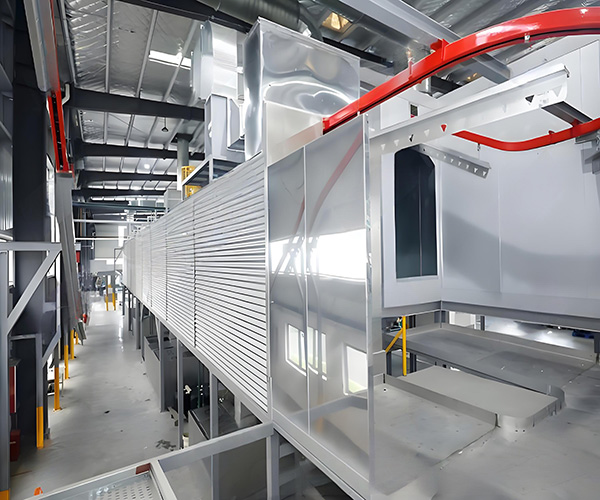
The aerospace coating line needs to integrate extreme environment resistant equipment and modular design. The following equipment selection is key:
Vacuum spray chamber:
Volume ≥20000L, equipped with supersonic spray gun and powder recovery system, recovery rate exceeds 99.5%, with HEPA filter element secondary filtration to ensure powder purity.
Explosion-proof design: using explosion-proof disc and explosion-proof valve, equipped with real-time dust concentration monitoring system, in line with the "Coating Operation Safety Regulations Powder Electrostatic Spraying Process Safety" (GB 15607-2008).
Laser curing device:
Adjustable power (500-2000W), focusing accuracy ≤0.1mm, equipped with water cooling system to ensure long-term stable operation.
Online monitoring module: Real-time monitoring of coating temperature field through infrared thermal imager to ensure curing uniformity.
Intelligent conveying system:
Vacuum suspension chain conveyor: carrying capacity up to 1000kg/m, chain speed 0.5-2m/min adjustable, equipped with anti-static chain and vacuum sealing device.
Carbon fiber ground rail conveyor: Made of carbon fiber material, with flexible turning radius, it can be used with accumulation design to achieve workpiece caching.
Environmental protection and energy-saving system:
Zeolite rotor + RTO incineration: VOCs treatment efficiency exceeds 99%, meeting the "Spacecraft Industrial Pollutant Emission Standard" (GB 21905-2008).
Heat recovery system: The waste heat of the curing furnace is used to heat the pre-treatment cleaning water, which increases the energy utilization rate by 30% and saves more than 1 million yuan per year.
3. Intelligent management: data-driven and full traceability
The full process monitoring is achieved through industrial Internet of Things technology, and the following systems are the core of intelligence:
Super intelligent central control system:
Intelligent system: Integrate the equipment control functions of each functional area of the coating line, and realize real-time monitoring, parameter adjustment and fault warning through visual terminals (touch screen, mobile phone, computer).
Seamless connection with ERP/MES: Realize the binding of production data with orders and work orders, and support production line scheduling, quality management, order tracking and product traceability.
Electronic intelligent data collection:
Multi-dimensional sensor network: deploy temperature, humidity, coating thickness, and radiation dose monitoring modules, and automatically upload data to the aerospace-grade cloud platform.
AI algorithm analysis: train models through historical data to predict equipment failures and coating defects, reducing the failure rate by 40%.
Quality traceability and compliance audit:
Unique QR code identification: Each aerospace product is bound to a QR code to record the powder spraying time, operator, test results, and radiation exposure data.
Blockchain evidence storage: key process parameters and test reports are uploaded to the chain to ensure that the data cannot be tampered with and meet the strict traceability requirements of aerospace certification.
IV. Case practice: Upgrade of a satellite company's coating line
A satellite manufacturing company achieved a performance leap through this design:
Process optimization:
Ultrasonic cleaning + plasma treatment is used for pretreatment, and vacuum spraying room and intelligent spray gun are used for spraying powder room, and the powder change speed is reduced from 60 minutes to 5 minutes.
The curing process is upgraded to laser curing + heat recovery system, reducing energy consumption by 35%.
Equipment upgrade:
Introducing vacuum hanging chain conveyor and graphene/epoxy composite coating preparation system, the spraying qualification rate of complex structural parts has increased to 99.8%.
Deployment of central control system to realize integrated control and digital management of the whole line.
Effect verification:
The radiation resistance of the coating reaches 10^7 Gy, and there is no oxidation phenomenon at a high temperature of 3000℃.
Production efficiency increased by 70%, and the annual output value jumped from 800 million yuan to 1.5 billion yuan, and passed ISO 13485 and NASA certification.
V. Future trend: deep integration of extreme and intelligent
Material extreme:
Develop coating materials that are resistant to ultra-high temperature (≥2000℃) and strong radiation (≥10^8 Gy), such as boron nitride nanotube composite coating.
Explore self-healing coating technology, release healing agents through microcapsules, and realize automatic repair of cracks.
Process intelligence:
Integrate AI visual inspection and digital twin technology to realize real-time simulation and optimization of the production process.
Promote augmented reality (AR) technology to assist operators in complex process debugging and equipment maintenance.
Flexibility in production:
Through modular design and rapid mold change technology, it can adapt to the needs of multi-variety and small-batch production, such as quickly switching from satellite components to rocket engine coating.
Develop mobile coating units to support on-site maintenance and in-situ coating of deep space probes.
The design of powder coating lines for aerospace products has gone beyond the traditional process framework and turned to the deep integration of extreme environment resistant materials, vacuum spraying processes, laser curing technology and intelligent management systems. Through the implementation of this solution, enterprises can achieve the goal of increasing coating reliability by 80% and doubling production efficiency, providing key technical support for deep space exploration, Mars colonization and other missions. In the future, with the breakthroughs in graphene materials, AI algorithms and extreme environment coating technologies, aerospace coating lines will enter a new era.
