


1. Industry background and trends
With the tightening of global environmental regulations and the implementation of the international standards for "Industrial Coatings" in 2025 (such as ISO 8130-6:2021, ASTM D3451), powder coatings with low VOC emissions have become the mainstream choice for surface treatment in the plastics industry. Data show that the annual growth rate of powder coatings in the automotive parts market is 12%. Its solvent-free and high utilization rate (more than 95%) characteristics make it an ideal solution for environmentally friendly coating.
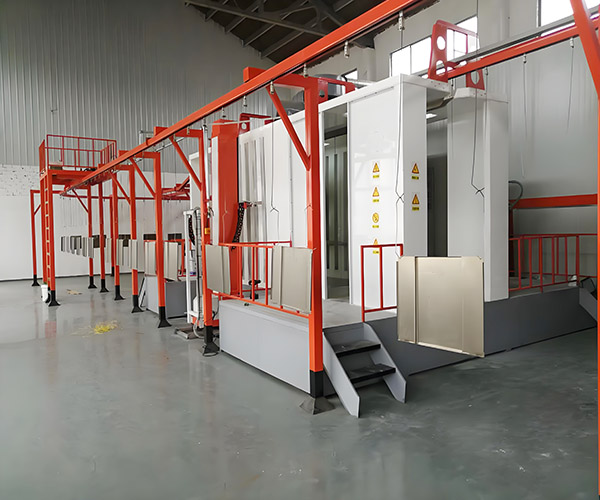
2. Design principles and core goals
Environmental protection first
The multi-stage powder recovery system (cyclone + filter element) is used, with a recovery rate of 98% to reduce dust emissions.
The use of low-temperature curing powder (below 120°C) reduces energy consumption by 30%, in line with ISO 14001 environmental management system requirements.
Energy-saving and efficient
Through the PLC+HMI automated control system, the powder spraying parameters (voltage, powder output) can be accurately adjusted to reduce human errors.
The intelligent scheduling system optimizes the production rhythm, increases equipment utilization by 30%, and reduces idle time by 15%.
Flexible adaptation
The modular design supports fast color change (completed within 5 minutes) and is suitable for small batch and multi-variety order requirements.
The accumulation and release conveyor line allows the workpiece to pause, avoiding temperature fluctuations in the curing furnace and ensuring product quality.
III. Detailed explanation of the process flow
1. Pretreatment
Chemical degreasing + ultrasonic cleaning: thoroughly remove oil and mold release agents on the plastic surface to ensure coating adhesion.
Static elimination and dust removal: Use high-voltage ionized air flow to solve the problem of plastic electrostatic adsorption of dust and improve coating uniformity.
2. Powder spraying and curing
Electrostatic spray gun selection:
Manual spray gun (Gema/Wagner brand): suitable for complex workpieces (such as special-shaped parts), voltage 60-100kV adjustable.
Automatic spray gun (ABB/Fanuc robot): multi-axis reciprocating spraying, powder output accuracy ±5%, suitable for mass production.
Curing furnace design:
Infrared radiation heating: rapid heating (5-10 minutes), suitable for heat-sensitive plastic materials.
Temperature uniformity ±5℃, insulation material thickness ≥150mm, air circulation system uniformity deviation <10%.
3. Recycling and post-processing
Multi-stage recycling system: cyclone separator + PTFE coated filter element, recycling efficiency >95%, annual powder cost savings of about 200,000 yuan.
Cooling device: water-cooled/air-cooled unit reduces the temperature of recycled powder to 25-30℃ to prevent agglomeration and clogging of the spray gun.
IV. Environmental protection and safety measures
Waste gas treatment: VOC waste gas treatment device ensures that emissions meet standards (in compliance with ISO 14001 and EU PPWR regulations).
Fire and explosion prevention: The powder spraying room uses explosion-proof motors, static elimination devices, and micro-negative pressure design (-10~-30Pa) to prevent dust explosions.
Operation safety: Regularly maintain equipment and train operators to master explosion-proof and first aid skills.
V. Case and data support
Case: After a group adopted a modular powder spraying line, the color change time was shortened by 50%, the equipment utilization rate was increased by 30%, and the annual VOCs emission was reduced by 12 tons.
Data: The efficient recycling system saves 200,000 yuan in powder costs per year; the intelligent scheduling system reduces idling time by 15% and saves 36,000 kWh of electricity per year.
VI. Future Development Trends
Intelligence: Integrate AI thickness sensors and AGV scheduling systems to achieve unmanned operation and real-time quality monitoring.
Material innovation: Low-temperature curing powder (below 120°C) is suitable for thermosensitive plastic materials to expand the application field.
Digitalization: Internet of Things technology enables remote monitoring and predictive maintenance of equipment to reduce downtime.
Conclusion
Through international standard process design, intelligent equipment selection and process optimization, the powder spraying line in the plastic industry can achieve the dual goals of efficient production and low emissions. In 2025, with stricter policies and technological innovation, modularization and intelligence will become the core direction of coating line upgrades. Enterprises need to keep up with the trend and plan ahead to gain an advantage in the competition.
