


In the field of medical supplies manufacturing, powder coating technology has become the mainstream choice for surface treatment due to its environmental protection, coating uniformity and corrosion resistance. This article combines industry practice and technological innovation to systematically explain the design points of powder coating line for medical supplies from four aspects: process flow, equipment selection, environmental optimization and intelligent management.
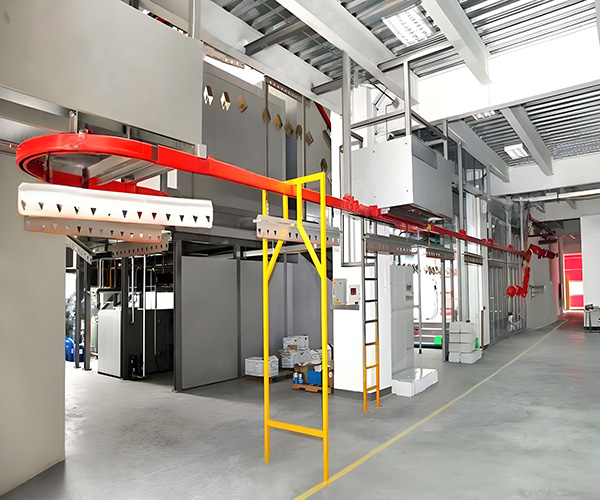
1. Core process flow design: closed-loop control from pre-treatment to finished product delivery
Medical supplies have extremely high requirements for the sterility, biocompatibility and corrosion resistance of the coating, and the process flow must strictly follow the medical industry standards (such as ISO 13485):
Pre-treatment:
Ultrasonic cleaning: Use a multi-slot ultrasonic cleaning machine to complete the three processes of degreasing (phosphorus-free medium temperature process), pickling (removal of oxide layer) and pure water cleaning in sequence to ensure that the surface is free of oil and impurities. For example, a medical catheter company has improved the coating adhesion by 50% through ultrasonic cleaning, and the salt spray test passing time has been extended to 2000 hours.
Plasma treatment: Plasma surface modification of complex structure medical products (such as implantable devices) to enhance powder adsorption and improve biocompatibility.
Powder spraying:
Electrostatic adsorption technology: Use a double filter electrostatic spray gun, the spray gun voltage is adjustable from -80 to -120kV, and the powder charge reaches 40-60μC/g to ensure uniform coverage of the surface of medical products. For example, after a surgical instrument company adopted this technology, the powder utilization rate increased from 70% to 85%, and the single-piece spraying time was shortened to 1 minute.
Multi-station collaboration: Design a rotating powder spraying room, cooperate with a robotic arm to achieve 360° no-dead-angle spraying, especially suitable for special-shaped medical products (such as joint prostheses). Through this design, a company has increased the spraying qualification rate of complex structural parts from 80% to 95%.
Curing and cooling:
Infrared + hot air circulation curing: The curing furnace uses full-bridge natural gas heating, temperature uniformity ±3℃, curing time 15-20 minutes (180-200℃), which is 50% more efficient than traditional ovens.
Aseptic cooling section: A 10-meter cooling zone is set up, equipped with a high-efficiency filtering and exhaust device to ensure that the workpiece temperature drops below 30℃ before leaving the oven to avoid coating cracking and microbial growth.
Post-processing:
Quality inspection: A film thickness meter (accuracy ±1μm), adhesion tester (grid method) and biocompatibility test (cytotoxicity test) are used to conduct full inspections on each batch of products. A company uses an AI visual inspection system to achieve a defect recognition accuracy of 99.9% and a missed detection rate of less than 0.1%.
Aseptic packaging: After qualified products are sterilized by VHP (vaporized hydrogen peroxide), they are packaged with medical-grade packaging materials to ensure sterility throughout the process.
2. Equipment selection: medical-grade certification and modular design
The coating line of medical supplies needs to take into account sterility, corrosion resistance and compliance. The core equipment selection recommendations are as follows:
Conveying system:
Stainless steel hanging chain conveyor: suitable for heavy medical supplies (such as operating tables), with a load capacity of 500kg/m, and an adjustable chain speed of 1-5m/min, which meets the requirements of GMP (Good Manufacturing Practice for Pharmaceuticals).
Medical-grade floor rail conveyor: used for small medical supplies (such as syringes), made of 316L stainless steel, with flexible turning radius, and can be used with accumulation design to achieve workpiece caching.
Powder spraying equipment:
Medical-grade large cyclone recovery system: The powder recovery rate exceeds 99%, and it is equipped with HEPA filter element for secondary filtration. The recovered powder can be directly reused, and the material cost is reduced by 20%.
Smart spray gun: built-in pressure sensor and flow controller, real-time adjustment of powder spraying amount, to ensure that the coating thickness error is ≤10μm. Through this technology, a certain company has reduced the powder consumption of a single piece from 200g to 160g.
Curing equipment:
Full-bridge natural gas oven: thermal efficiency reaches 90%, which is 35% more energy-saving than electric heating. It is equipped with a real-time temperature monitoring system, and data is automatically uploaded to the cloud platform.
Modular infrared heating plate: faulty units can be quickly replaced, maintenance time is shortened to less than 20 minutes, and downtime losses are reduced.
Environmental protection equipment:
Zeolite rotor + RTO incineration: VOCs treatment efficiency exceeds 98%, meeting the "Medical Device Industry Pollutant Emission Standard" (GB 21904-2008).
Pulse backwash filter cartridge: filtration accuracy reaches 0.1μm, equipped with explosion-proof design, in line with the "Painting Operation Safety Regulations Powder Electrostatic Spraying Process Safety" (GB 15607-2008).
III. Intelligent management: data-driven and full-process traceability
Full-process monitoring is achieved through industrial Internet of Things technology to improve production efficiency and quality stability:
Real-time data collection:
Deploy temperature, humidity, coating thickness sensors and microbial detection modules, upload data to the medical-grade cloud platform, and generate compliance reports. A company reduced the equipment failure rate by 30% by analyzing historical data through AI algorithms.
Remote operation and maintenance:
Engineers can adjust the spray gun parameters and monitor the oven temperature through mobile phone APP to achieve "unmanned" duty. A company shortened the equipment maintenance response time from 3 hours to 1 hour through the remote diagnosis system.
Quality traceability:
Each medical supply is bound to a unique QR code to record the spraying time, operator, test results and sterilization batch, which is convenient for after-sales problem tracing and compliance audit. A company reduced the customer complaint rate from 2% to 0.3% through this system.
IV. Environmental optimization: from waste gas treatment to dust recovery
Medical supplies coating must strictly follow environmental protection and safety standards. Key measures include:
Waste gas purification:
Activated carbon adsorption + catalytic combustion: suitable for low-concentration waste gas, operating costs are reduced by 45%, and there is no secondary pollution, which complies with the "Comprehensive Emission Standards for Air Pollutants" (GB 16297-1996).
Dust recovery:
Explosion-proof design: The powder spraying room uses explosion-proof discs and explosion-proof valves, equipped with a real-time dust concentration monitoring system to ensure safe operation.
Energy-saving technology:
Heat recovery system: Use the waste heat of the curing furnace for pre-treatment cleaning water heating, increase energy utilization by 25%, and save more than 500,000 yuan per year.
V. Case analysis: Practice of coating line upgrade of a medical catheter enterprise
A medical catheter enterprise has achieved a double breakthrough in production capacity and quality through the upgrade of the fully automatic powder coating line:
Process optimization: The pre-treatment is changed from manual wiping to ultrasonic cleaning + plasma treatment, and the spray powder room adopts internationally advanced intelligent spray guns, and the powder change speed is reduced from 40 minutes to 8 minutes.
Equipment upgrade: The introduction of stainless steel hanging chain conveyor and super large steering device has increased the qualified rate of spraying of complex structural parts to 98%, and the curing effect has reached the international advanced level.
Intelligent management: Deploy sensors and medical-grade cloud platforms, reduce equipment failure rate by 40%, increase production efficiency by 50%, and increase annual output value from 80 million yuan to 200 million yuan.
VI. Future trends: intelligent, green, and personalized
Intelligent: Integrate AI visual inspection and digital twin technology to realize the digitization and visualization of the production process and meet the strict traceability requirements of medical certification.
Greening: Promote water-based powder coatings and low-temperature curing technology to reduce energy consumption and emissions, in line with the global medical environmental protection trend.
Personalization: Through modular design and rapid mold change technology, it adapts to the needs of multi-variety and small-batch production, and helps precision medicine and personalized equipment manufacturing.
The design of medical powder coating lines needs to balance sterility, efficiency and environmental protection. Through medical-grade equipment, intelligent control and closed-loop process management, companies can achieve the dual goals of improving coating quality by 40% and reducing energy consumption by 25%. In the future, with the breakthrough of AI visual inspection and biocompatible materials, coating lines will move towards the "zero defect, zero pollution" medical 4.0 standard.
