


In the field of aluminum processing, powder spraying technology has become the mainstream choice for surface treatment due to its environmental protection, coating uniformity and cost-effectiveness. This article combines industry practice and technological innovation, and systematically explains the design points of aluminum powder spraying line from four aspects: process flow, equipment selection, environmental optimization and intelligent management.
1. Core process design: closed-loop control from pre-treatment to finished product delivery
The core process of the aluminum powder spraying line needs to cover five major links: pre-treatment, powder spraying, curing, cooling, and post-treatment, and customize the process according to the characteristics of aluminum materials (such as oxide film and surface flatness):
Pre-treatment:
Chemical cleaning: Use a spray or immersion automatic cleaning line to complete the three processes of degreasing (phosphorus-free medium-temperature process), pickling (removing the oxide layer), and phosphating (forming an anti-rust film) in sequence. For example, an aluminum profile company increased the adhesion of the coating by 40% through phosphating treatment, and the passing time of the salt spray test was extended to 1000 hours.
Physical treatment: Add a sandblasting process to complex structural aluminum materials (such as radiator fins), with a surface roughness of Ra3.2-6.3μm, to enhance the adsorption of powder.
Powder spraying:
Electrostatic adsorption technology: Use a double-filter electrostatic spray gun, the spray gun voltage is adjustable from -60 to -100kV, and the powder charge reaches 30-50μC/g, ensuring uniform coverage of the aluminum surface. For example, after a door and window company adopted this technology, the powder utilization rate increased from 75% to 88%, and the single-piece spraying time was shortened to 1.2 minutes.
Multi-station collaboration: Design a rotating powder spraying room, cooperate with a robotic arm to achieve 360° no-dead-angle spraying, especially suitable for special-shaped aluminum materials (such as curved pipes). Through this design, a certain automotive parts company has increased the spraying qualification rate of complex structural parts from 82% to 95%.
Curing and cooling:
Infrared + hot air circulation curing: The curing furnace uses full-bridge natural gas heating, temperature uniformity of ±5℃, and curing time of 15-20 minutes (180-200℃), which is 50% more efficient than traditional ovens.
Natural cooling section: set up a 10-meter cooling zone, equipped with a forced exhaust device to ensure that the temperature of the workpiece drops below 40°C before leaving the furnace to avoid cracking of the coating.
Post-processing:
Quality inspection: use a film thickness meter (accuracy ±1μm) and an adhesion tester (grid method) to conduct random inspections on each batch of products. A certain company uses an AI visual inspection system, with a defect recognition accuracy of 99.7% and a missed detection rate of less than 0.3%.
Repair and packaging: Manually spray local defects (such as pinholes), and qualified products are stored after dust-proof packaging.
2. Equipment selection: Modular design adapts to diverse needs
The aluminum powder spraying line needs to take into account versatility, flexibility and economy. The core equipment selection recommendations are as follows:
Conveying system:
Suspension chain conveyor: suitable for heavy aluminum materials (such as curtain wall panels), with a load capacity of 300kg/m and an adjustable chain speed of 1-5m/min. A certain company uses frequency conversion control technology to reduce the energy consumption of transportation by 20%.
Track conveyor: used for small aluminum materials (such as electronic radiators), with a small footprint and flexible turning radius, and can be used with an accumulation design to achieve workpiece caching.
Powder spraying equipment:
Large cyclone recovery system: The powder recovery rate exceeds 98%, and it is matched with a pulse filter element for secondary filtration. The recovered powder can be directly reused, and the material cost is reduced by 15%.
Intelligent spray gun: Built-in pressure sensor and flow controller, real-time adjustment of powder spraying amount to ensure that the coating thickness error is ≤15μm. Through this technology, a certain company has reduced the powder consumption of a single piece from 180g to 150g.
Curing equipment:
Full-bridge natural gas oven: The thermal efficiency reaches 85%, which is 30% more energy-saving than electric heating, and is suitable for large-scale continuous production.
Modular infrared heating plate: Faulty units can be quickly replaced, and maintenance time is shortened to less than 30 minutes, reducing downtime losses.
Environmental protection equipment:
Zeolite rotor + RTO incineration: VOCs treatment efficiency exceeds 95%, meeting the "Comprehensive Emission Standards for Air Pollutants" (GB 16297-1996).
Pulse backwash filter cartridge: filtration accuracy reaches 0.1μm, and the recovered powder can be directly reused to reduce waste.
3. Intelligent management: data-driven production optimization
Use industrial Internet of Things technology to achieve full process monitoring and improve production efficiency and quality stability:
Real-time data collection:
Deploy temperature, humidity, and coating thickness sensors, upload data to the cloud platform, and generate production reports. A company analyzed historical data through AI algorithms and reduced the equipment failure rate by 25%.
Remote operation and maintenance:
Engineers can adjust the spray gun parameters and monitor the oven temperature through mobile phone APP to achieve "unmanned" duty. A company shortened the equipment maintenance response time from 4 hours to 1 hour through a remote diagnosis system.
Quality traceability:
Each piece of aluminum is bound to a unique QR code to record the powder spraying time, operator, and test results, which is convenient for after-sales problem tracing. A company reduced the customer complaint rate from 3% to 0.5% through this system.
4. Environmental optimization: from waste gas treatment to dust recovery
Aluminum powder spraying must strictly follow environmental protection standards, and key measures include:
Waste gas purification:
Activated carbon adsorption + catalytic combustion: suitable for low-concentration waste gas, operating costs are reduced by 40%, and there is no secondary pollution.
Dust recovery:
Explosion-proof design: The powder spraying room uses explosion-proof discs and explosion-proof valves, which comply with the "Safety Regulations for Coating Operations Powder Electrostatic Spraying Process Safety" (GB 15607-2008).
Energy-saving technology:
Heat recovery system: The waste heat of the curing furnace is used for pre-treatment cleaning water heating, and the energy utilization rate is increased by 20%.
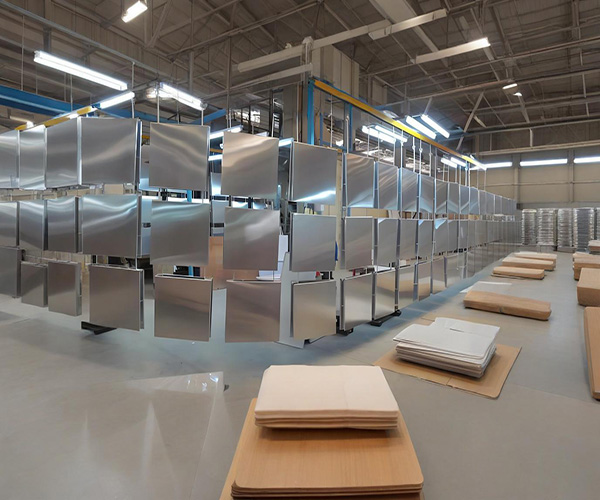
V. Case analysis: Chongqing Haisu Nanbang Aluminum Industry Powder Spraying Line Upgrade Practice
An aluminum company has achieved a dual improvement in production capacity and quality through the upgrade of the vertical spraying line:
Process optimization: The pre-treatment is changed from manual immersion to automatic waterfall spraying, and the spray powder room uses internationally advanced automatic spray guns, and the powder change speed is reduced from 30-40 minutes to 5-10 minutes.
Equipment upgrade: The introduction of hanging conveyors and super-large steering devices has increased the qualified rate of spraying of complex structural parts to 95%, and the curing effect has reached the international advanced level.
Intelligent management: Deployment of sensors and cloud platforms has reduced the equipment failure rate by 30%, increased production efficiency by 40%, and the annual output value has jumped from 160 million yuan to 350 million yuan.
VI. Future trends: intelligence, greening, and flexibility
Intelligence: Integrate AI visual inspection and digital twin technology to realize the digitization and visualization of the production process.
Greening: Promote water-based powder coatings and low-temperature curing technology to reduce energy consumption and emissions.
Flexibility: Through modular design and rapid mold change technology, it can adapt to the needs of multi-variety and small-batch production.
The design of aluminum powder spraying lines needs to balance efficiency, cost and environmental protection. Through modular equipment, intelligent control and closed-loop process management, enterprises can achieve the dual goals of improving coating quality by 30% and reducing energy consumption by 20%. In the future, with the application of AI visual inspection and digital twin technology, powder spraying lines will move towards the "zero defect, zero waste" industry 4.0 standard.
