


Full strategy for powder spraying line design in woodworking industry: efficient, environmentally friendly and intelligent solutions
In the woodworking industry, powder spraying technology has gradually become the mainstream choice for furniture surface treatment due to its environmental protection, coating uniformity and cost-effectiveness. This article combines industry practice and technological innovation, and systematically explains the design points of woodworking powder spraying line from four aspects: process flow, equipment selection, environmental optimization and intelligent management.
1. Process design: closed-loop control from pre-treatment to finished product delivery
The core process of the woodworking powder spraying line includes four major links: pre-treatment, powder spraying, curing, and cooling. The process needs to be customized according to the characteristics of wood (such as moisture content and texture density):
Pre-treatment:
Physical cleaning: Use sandblasting or shot blasting to remove burrs and oil stains on the wood surface to improve coating adhesion. For example, a solid wood furniture company reduced the coating shedding rate by 30% through sandblasting.
Chemical degreasing: Use phosphorus-free degreasing agent to soak or spray to remove the decomposed grease inside the wood to avoid bubbles after powder spraying.
Sealing treatment: Apply sealant to porous wood (such as pine) to prevent powder penetration and uneven coating thickness.
Powder spraying link:
Electrostatic adsorption technology: The spray gun is connected to the negative pole, the workpiece is grounded, and the powder is evenly adsorbed on the wood surface under the action of corona discharge. For example, a custom cabinet company uses a double-filter electrostatic spray gun, and the powder utilization rate reaches 85%, which is 40% higher than traditional manual spraying.
Multi-station collaboration: Design a rotating powder spraying room to achieve 360° coverage of the workpiece without dead angles, and cooperate with the robotic arm to automatically spray complex structures (such as carved parts) to reduce manual intervention.
Curing and cooling:
Infrared + hot air circulation curing: Infrared quickly heats up to 180-200℃, hot air circulation ensures uniform temperature, and the curing time is shortened to 15-20 minutes, which is 50% more efficient than traditional ovens.
Natural cooling section: Set up a 5-10 meter cooling zone to prevent high-temperature workpieces from directly contacting the air and causing cracking of the coating.
2. Equipment selection: Modular design adapts to diverse needs
The woodworking powder spraying line needs to take into account versatility and flexibility. The core equipment selection recommendations are as follows:
Conveying system:
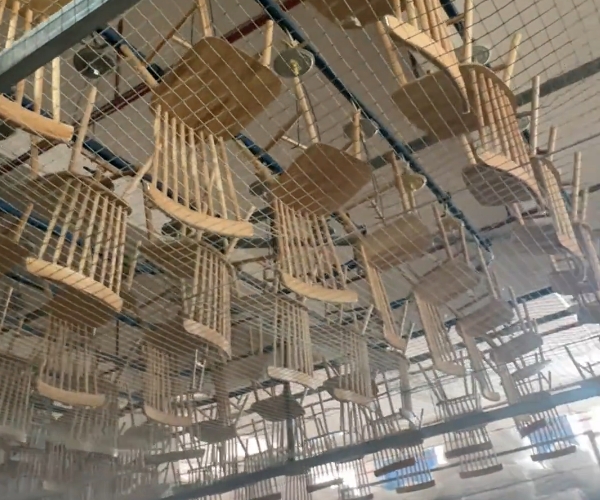
Suspension chain conveyor: suitable for heavy panels (such as door panels), with a load capacity of 200kg/meter, and adjustable chain speed (1-5m/min).
Ground rail conveyor: used for small workpieces (such as chair legs), with a small footprint and flexible turning radius.
Powder spraying equipment:
Large cyclone recovery system: Powder recovery rate exceeds 98%, and it is matched with pulse filter element for secondary filtration to reduce material costs.
Intelligent spray gun: Built-in pressure sensor and flow controller, real-time adjustment of powder spraying amount, ensuring coating thickness error ≤10μm.
Curing equipment:
Full bridge natural gas oven: Thermal efficiency reaches 85%, which is 30% energy-saving than electric heating and suitable for large-scale continuous production.
Modular infrared heating plate: Faulty units can be replaced quickly, and maintenance time is shortened to less than 30 minutes.
III. Environmental protection optimization: from waste gas treatment to dust recovery
Woodworking powder spraying must strictly follow environmental protection standards, and key measures include:
Waste gas purification:
Zeolite wheel + RTO incineration: VOCs treatment efficiency exceeds 95%, meeting the "Comprehensive Emission Standards for Air Pollutants" (GB 16297-1996).
Activated carbon adsorption + catalytic combustion: Suitable for low-concentration waste gas, operating costs are reduced by 40%.
Dust recovery:
Pulse back-blowing filter cartridge: The filtration accuracy reaches 0.1μm, and the recovered powder can be directly reused to reduce waste.
Explosion-proof design: The powder spraying room adopts explosion-proof discs and explosion-proof valves, which comply with the "Safety Regulations for Coating Operations Powder Electrostatic Spraying Process Safety" (GB 15607-2008).
IV. Intelligent management: data-driven production optimization
Full-process monitoring through industrial Internet of Things technology:
Real-time data collection:
Deploy temperature, humidity, and coating thickness sensors, upload data to the cloud platform, and generate production reports.
A company analyzed historical data through AI algorithms and reduced the equipment failure rate by 25%.
Remote operation and maintenance:
Engineers can adjust the spray gun parameters and monitor the oven temperature through mobile phone APP to achieve "unmanned" duty.
Quality traceability:
Each workpiece is bound to a unique QR code to record the powder spraying time, operator, and test results, which is convenient for after-sales problem tracing.
Conclusion
The design of woodworking powder spraying lines needs to balance efficiency, cost and environmental protection. Through modular equipment, intelligent control and closed-loop process management, enterprises can achieve the dual goals of improving coating quality by 30% and reducing energy consumption by 20%. In the future, with the application of AI visual inspection and digital twin technology, powder spraying lines will move towards the "zero defect, zero waste" Industry 4.0 standard.
