


I. Industry characteristics and design challenges
The requirements of the home appliance industry (such as refrigerators, washing machines, and air conditioners) for powder coating lines are both efficient production and environmental compliance: the coating must meet the ISO 2409:2020 adhesion standard (cross-cut test) and the GB/T 9286-2021 corrosion resistance requirements, while adapting to the characteristics of multi-variety and high-beat production. The pass rate of traditional spraying lines is only 88%, and the main problems are uneven coating thickness (±12μm deviation) and color difference (ΔE≥1.8). In addition, the environmental pressure is significant, and it is necessary to comply with the EU REACH and RoHS directives and the Chinese GB 30981.2-2025 standard to control VOCs emissions (for example, a home appliance company reduced VOCs emissions by 620 tons/year through "oil-to-powder").
2. Core Design Points
1. Equipment Selection and Layout Optimization
Spray Gun System: The use of a rotating atomizing disc spray gun (rotation speed 12000rpm) with edge enhancement technology increases the coverage rate of deep cavity parts (such as refrigerator liner) to 99%. The practice of a certain enterprise shows that this solution reduces the standard deviation of the coating thickness on the inner side of the workpiece from 5.0μm to 2.2μm (in line with the ISO 8130-6 gel time standard).
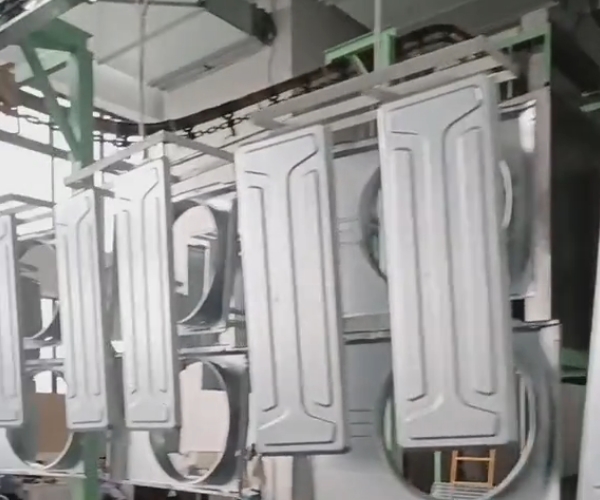
Conveying System: The accumulation and release suspension chain (pitch 150mm) is matched with the workpiece rotation mechanism (6rpm) to ensure the uniformity of multi-faceted spraying. After a certain project adopted this design, the production cycle was increased to 4 pieces/minute (meeting the ISO 50058 explosion-proof requirements).
Recovery Device: Cyclone separation + pulse filter composite system, the dust concentration is controlled below 1mg/m3 (in line with the EU ATEX Directive).
2. Energy-saving process integration
Waste heat recovery system: The exhaust gas from the curing furnace is preheated with fresh air through a plate heat exchanger. A case study shows that natural gas consumption is reduced by 28% (a case of a home appliance company in Zhejiang).
Frequency conversion control strategy: The fan power is adjusted according to the real-time load, and the wind speed fluctuation in the spray room is controlled within ±0.1m/s, saving 250,000 kWh of electricity per year (EU ATEX directive compatible design).
3. Intelligent transformation plan
Automatic color change system: Using a central powder supply center (12-color independent pipelines), the color change time is shortened to 35 seconds, and the powder waste rate is less than 0.2% (REACH regulation VOC control).
AI visual inspection: Deploy 3D line laser sensors to monitor the coating thickness in real time (accuracy ±1.2μm), and the defect detection rate is increased from 85% of manual inspection to 99.8% (in compliance with ISO 15607 wind speed control standards).
3. Key steps for installation and commissioning
1. Pre-treatment process installation
Using ultrasonic degreasing + phosphating process, the surface cleanliness of the workpiece reaches ISO level 4 (BS 3900 series standard).
The spray liquid is dispersed through the spiral body in the nozzle to form a mist liquid. The spray pressure needs to be accurately calculated to avoid mixing.
2. Safety and environmental protection measures
Safety protection: The powder spraying room is equipped with infrared gratings and safety door locks to achieve 0.3 seconds emergency stop (GB 15607-1995 safety standard).
Dust control: The laminar air supply system maintains a vertical airflow of 0.3m/s in the spraying room, and is equipped with automatic exhaust and fresh air linkage devices (REACH regulation VOC control).
Waste gas treatment: Install RTO incinerator, VOCs emission concentration <20mg/m3 (a case of a home appliance company).
3. Intelligent system integration
Digital twin technology: simulate the impact of standard changes through virtual debugging, adjust the spray trajectory and curing curve in advance, and shorten the certification cycle by 55% (ISO 22400 key feature verification).
Internet of Things platform: real-time monitoring of each node data, abnormal energy consumption response speed increased by 75% (a case of a home appliance company).
IV. Typical cases and data results
A home appliance company: through the "oil to powder" process, VOCs emissions are reduced by 620 tons per year, the paint utilization rate reaches more than 96%, and the amount of hazardous waste is greatly reduced.
A home appliance company in Wuhan, China: After the intelligent transformation, the spray workshop has realized a "dark factory", the production capacity has increased to 1.5 billion yuan, the color change time has been shortened to 20 seconds, and the product qualification rate has been significantly improved.
V. Future trends and response strategies
Low-temperature curing technology: UV-LED curing equipment (wavelength 395nm) shortens the curing time to 3 seconds and reduces energy consumption by 50%.
Fluorinated additives: Develop fluorinated additives such as silane and sand graining agents to replace defoamers containing PFCAs (REACH regulations in 2023).
Modular design: The curing oven adopts a building block combination to adapt to different workpiece sizes, and the thermal efficiency remains above 94%.
