


The quality of finished products on industrial spray painting assembly lines depends entirely on standardized process flows. Many factories encounter problems such as paint peeling, sagging, pinholes, and poor adhesion during spray painting, which are essentially caused by non-standard process flow and missing key steps. This article provides a detailed explanation of the complete set of standard production processes for fully automatic spray painting lines, covering the painting needs of industrial general workpieces.
Step 1: Pre treatment of the workpiece, the fundamental core of coating quality. Before formal painting, the entire process of degreasing, water washing, rust removal, dust removal, and drying must be carried out to thoroughly remove oil stains, oxide scales, rust, dust and impurities on the surface of the workpiece. The workpiece substrate must be clean and dry to ensure tight adhesion of the paint, avoid peeling, peeling, and foaming in the later stage, and greatly improve the service life of the coating.
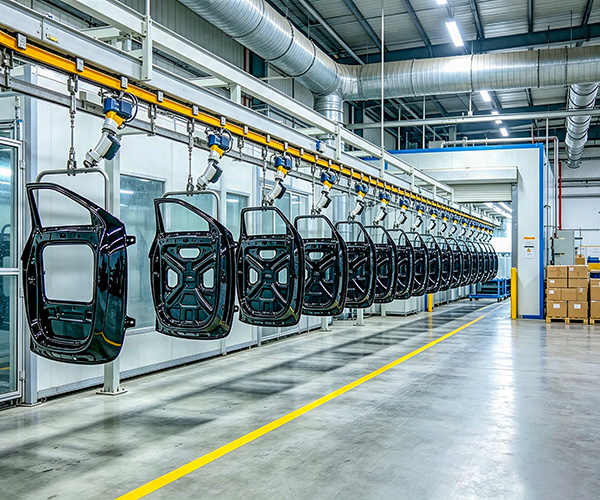
Step 2: Hang and transport the workpiece. Hang the processed workpieces neatly on the hooks of the assembly line, adjust the speed of the conveyor chain, match the running rhythm according to the size and paint requirements of the workpieces, ensure sufficient spraying and drying time, and adapt to different painting needs of workpieces.
Step 3: Dust free automatic spraying operation. The workpiece enters the enclosed dust-free spraying room, and the automatic reciprocating spray gun or spraying robot sprays at a constant speed according to the preset trajectory, accurately controlling the paint output, atomization pressure, and spraying distance, achieving all-round coverage of the workpiece, no dead corners, no missed spraying, and ensuring uniform and delicate paint film. Complex and irregular workpieces can be matched with manual spray painting to improve the paint surface of corners and dead corners.
Step 4: Leveling and volatilization process. After the spraying is completed, the workpiece enters the leveling area and is left to evaporate the internal thinner and organic solvent of the paint, avoiding direct high-temperature baking that may cause bubbles, pinholes, and orange peel on the paint surface. This allows the paint surface to naturally level, improving flatness and glossiness.
Step 5: Constant temperature drying and curing. The flattened workpiece enters the hot air circulation drying furnace, and the standard temperature and time are set according to the paint material. The constant temperature baking allows the paint to completely cure and dry, forming a dense, wear-resistant, and corrosion-resistant protective decorative coating.
Step 6: Cooling quality inspection and warehousing. After drying, the workpiece is naturally cooled, and the staff inspects the paint surface for defects. Qualified products are packaged and stored, and defective products are uniformly reworked and rectified to ensure the quality of the finished products before leaving the factory.
