


I. Industry characteristics and design challenges
The requirements of hardware tools for spraying lines are both functional and economical: complex workpieces need to solve the edge coverage problem, the coating needs to meet the ISO 2409:2020 adhesion standard (grid test), and the production rhythm needs to adapt to the characteristics of multiple varieties and small batch orders. A case of a hardware enterprise shows that the qualified rate of traditional spraying lines is only 85%, and the main problems are uneven coating thickness (±10μm deviation) and color difference (ΔE≥1.5).
II. Core design points
①. Equipment selection and layout optimization
Spray gun system: The use of a rotating atomizing disc spray gun (speed 10000rpm) combined with edge enhancement technology increases the coverage rate of deep cavity parts to 98%. The practice of a certain enterprise shows that this solution reduces the standard deviation of the coating thickness on the inside of the tool from 4.5μm to 2.0μm (in line with ISO 8130-6 gel time standard).
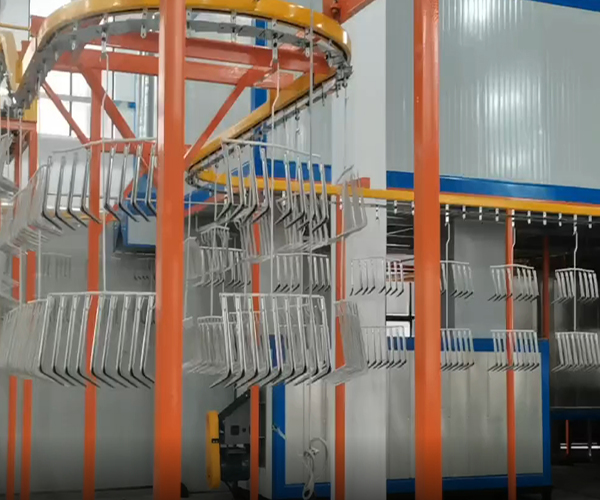
Conveying system: Accumulated and released suspension chain (pitch 120mm) with workpiece self-rotation mechanism (5rpm) to ensure uniformity of multi-faceted spraying. After adopting this design in a project in Guangdong, the production cycle was increased to 3 pieces/minute (meeting ISO 50058 explosion-proof requirements).
②. Energy-saving process integration
Waste heat recovery system: The exhaust gas of the curing furnace is preheated with fresh air through a plate heat exchanger. A case shows that natural gas consumption is reduced by 25% (in compliance with ISO 14001 energy management requirements).
Frequency conversion control strategy: The fan power is adjusted according to the real-time load, and the wind speed fluctuation in the spray room is controlled within ±0.15m/s, saving 200,000 kWh of electricity per year (EU ATEX directive compatible design).
③. Intelligent transformation plan
AI visual inspection: Deploy 3D line laser sensors to monitor coating thickness in real time (accuracy ±1.5μm), and the defect detection rate is increased from 80% of manual inspection to 99.5% (in compliance with ISO 15607 wind speed control standards).
Automatic color change system: With a central powder supply center (8-color independent pipelines), the color change time is shortened to 40 seconds, and the powder waste rate is less than 0.3% (REACH regulation VOC control).
3. Typical case analysis
Renovation project of a hardware enterprise in Zhejiang, China:
Pretreatment optimization: Ultrasonic degreasing + phosphating process is adopted, and the surface cleanliness of the workpiece reaches ISO level 4 (BS 3900 series standard).
Curing furnace upgrade: three-stage temperature control (preheating zone 160℃/main curing zone 210℃/cooling zone 90℃), thermal efficiency is increased to 93% (in line with ISO 9001 quality management system).
Compliance data: unit energy consumption 0.24kgce/㎡, VOCs emission <25mg/m3 (EU CE certification requirements).
4. Future standard trends and response strategies
Fluorination-free technology: Develop fluorine-free additives such as silane and sand grain agent to replace defoamers containing PFCAs (REACH regulation 2023 restrictions).
Digital twin verification: simulate the impact of standard changes through virtual debugging, adjust the spraying trajectory and curing curve in advance, and shorten the certification cycle by 50% (ISO 22400 key feature verification).
